Colombia will hold the first round of its presidential elections on May 31. The country operates under a presidential system in which any candidate who fails to secure more than 50% of the vote advances to a runoff election, scheduled for June 21. Voting is not mandatory. Turnout this Sunday is expected to range between 22 and 24 million voters, representing less than 60% of the electoral roll.
The election takes place at a particularly complex moment. Outgoing President Gustavo Petro’s administration (the first left-wing government in the country’s history) is ending amid fiscal constraints, mounting pressure on the healthcare system, deteriorating public security conditions, and a cautious investment environment.
The campaign quickly evolved into a confrontation between the left and the right, leaving the political center with little visibility. The most likely outcome is that Colombia will not elect a new president on May 31 but rather determine which two candidates will compete for the presidency in the June 21 runoff.
The Three Candidates with Real Chances
The campaign quickly evolved into a confrontation between the left and the right, leaving the political center with little visibility. The most likely outcome is that Colombia will not elect a new president on May 31 but rather determine which two candidates will compete for the presidency in the June 21 runoff.
Iván Cepeda • Pacto Histórico
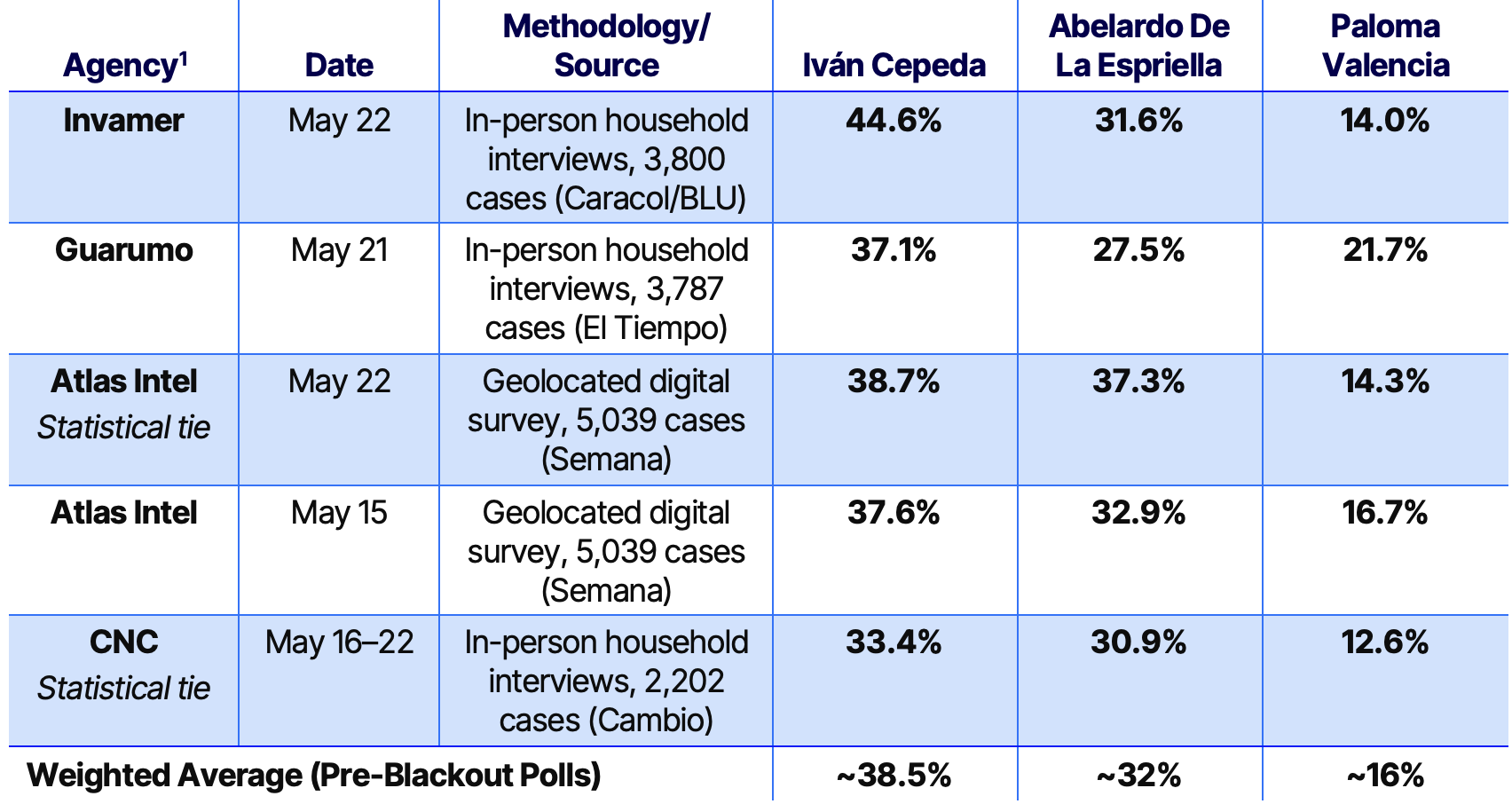
A left-wing senator with a long track record on human rights and peace issues, he is running as the continuity candidate for the Petro administration. Every major poll places him as the leading candidate heading into Sunday’s vote, with support ranging from 33% to 44% depending on the polling firm, making his advancement to the runoff all but certain. The challenge he is likely to face in June is not consolidating his own base but overcoming high rejection rates: 42.9% of Colombians say they would never vote for him, the highest unfavorable rating among the three leading candidates.
Paloma Valencia • Centro Democrático
A center-right senator historically associated with former President Álvaro Uribe, she entered the race as the most voted candidate in the March 8 primary coalition elections, which drew nearly 6 million voters nationwide. She also has the backing of several parties with representation in Congress. However, recent polling shows her losing momentum, with support ranging from 12.6% to 21.7% depending on the polling firm. The key question is whether her party machinery and the electoral base demonstrated in the primaries will translate on election day into stronger results than current polls suggest.
Abelardo De La Espriella • Defensores de la Patria
A trial lawyer with no previous electoral career, he has emerged as the surprise phenomenon of the final stretch of the campaign. He positioned himself as a right-wing voice distinct from the traditional parties: more confrontational, more emotional, and with a strong presence on social media. Throughout May, his support rose between 10 and 15 points depending on the poll, reaching a statistical tie with Cepeda in two of the four major surveys. The central question is whether this surge reflects a genuine expansion of voter support or an electorate that polling firms are struggling to measure accurately.
The center: Sergio Fajardo and Claudia López
Two centrist candidates complete the relevant electoral landscape: Sergio Fajardo, former mayor of Medellín and former governor of Antioquia, known for transforming the city through social urbanism and education policies; and Claudia López, former mayor of Bogotá with a strong anti-corruption profile. Neither is expected to reach the runoff since polls place them between 1% and 4%, but their urban and independent voter base could prove decisive in determining the outcome in June.
Sergio Fajardo
He has been explicit: he will not support any runoff candidate unconditionally. Any political negotiation would have to involve concrete commitments on defending democracy, fighting corruption, and rejecting polarization. He is unlikely to enter the conversation as a political ally, but rather as someone setting the terms for his endorsement.
Claudia López
Her position could be more pragmatic than Fajardo’s. If she sees room to influence the next government’s agenda, particularly on anti-corruption measures, public security, and social protection, she could be open to negotiation. Her urban, centrist voter base is likely to become one of the main constituencies contested by the two finalists.
The Polls: What They Show and What They Omit
In 2025, Colombia passed a law that tightened the technical requirements for polling, including larger sample sizes, mandatory regional representation, and greater state oversight. Paradoxically, the result has not been greater convergence among pollsters, but more visible differences between them. Two of the four surveys published before the blackout period show Cepeda and Abelardo in a statistical tie, while the other two give Cepeda a clear lead. The explanation is not necessarily that one of them is wrong, but that each methodology captures a different electorate. Atlas Intel, for example, relies on geolocated digital recruitment, reaching the kind of voter who is active online. The other firms conduct in-person household interviews, a method that can sometimes limit how openly respondents express their preferences.
Three factors that do not fully appear in the polls:
- The primary election baseline: Paloma Valencia heads into Sunday with the backing of nearly 6 million votes obtained in the March 8 primary coalition election. That electoral base is not fully reflected in current voting intention polls.
- Abelardo’s electorate: His supporters are part of a new right-wing movement that is highly active on social media but has not yet been tested in previous electoral cycles.
- Party machinery: The parties supporting Valencia have real grassroots structures and mobilization capacity on election day that conventional opinion polls do not always capture accurately.
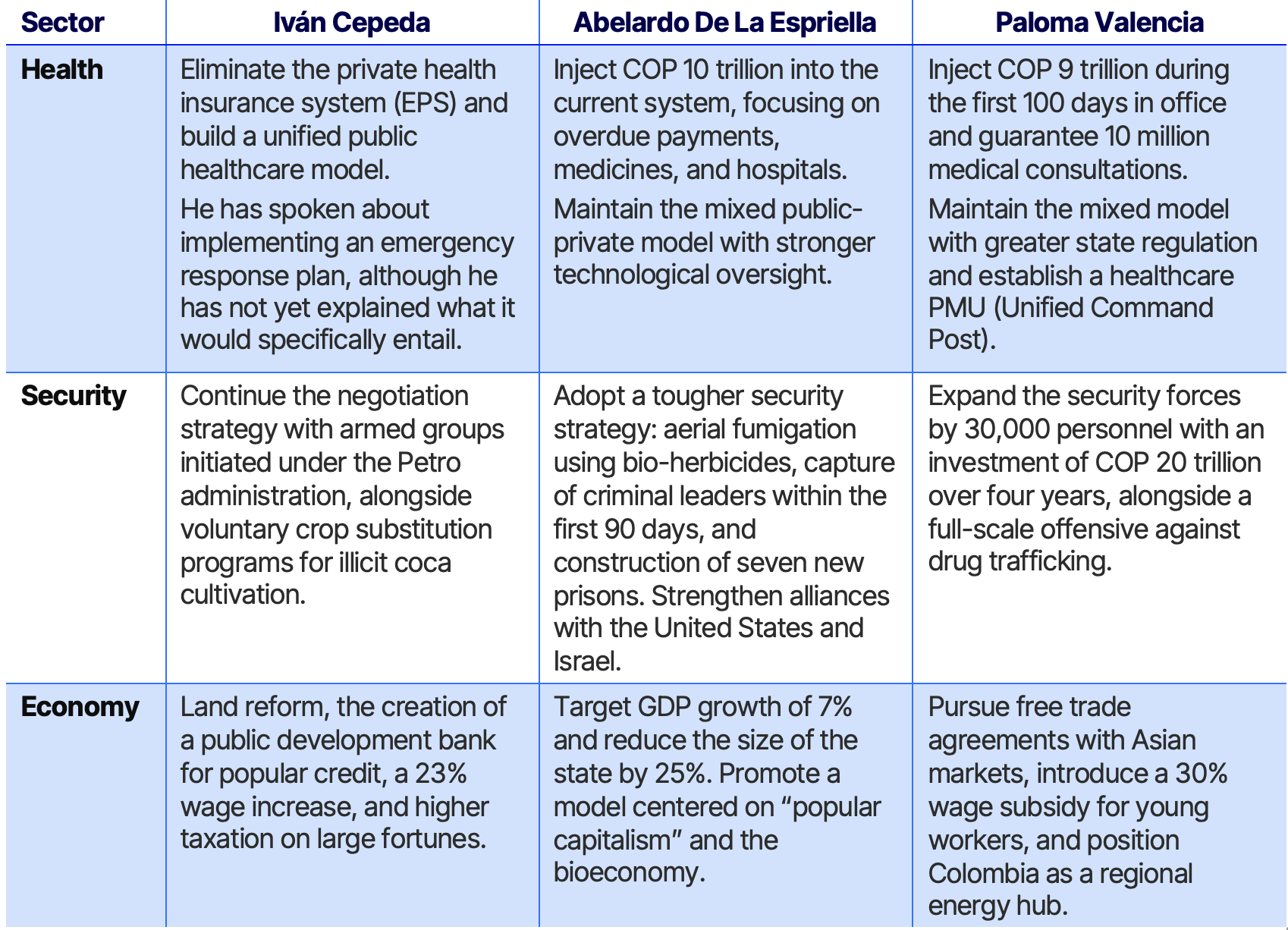
Frontrunners' Proposals
Insights
Cepeda is heading to the runoff. What Sunday’s vote will determine is who will face him in June, and that question has two possible answers each with very different implications for the country and for those operating in it.
- If Abelardo De La Espriella advances, Colombia would face its most polarized runoff election in years. He is a candidate with no previous electoral track record, but he would enter the second round backed by a new and highly energized electorate, competing against the candidate representing continuity with the outgoing government and a strong party structure. Runoff scenarios from Atlas Intel and Centro Nacional de Consultoría show Abelardo De La Espriella defeating Cepeda. Polls also suggest that, in this scenario, blank voting would increase in the second round.
- If Paloma Valencia advances, Iván Cepeda would face a candidate with established party machinery and a detailed government platform that could help consolidate centrist voters around a programmatic agenda. Guarumo polling shows her defeating Cepeda by a wider margin than De La Espriella. But before thinking about the runoff, her immediate challenge is qualifying for it.
- The centrist vote, particularly supporters of Sergio Fajardo and Claudia López, will be decisive. Neither Fajardo nor López is expected to offer support unconditionally. The coming weeks are likely to involve political negotiations as significant as the campaign itself.
For the business sector, the two most likely runoff scenarios present substantial differences in regulatory policy, openness to investment, relations with key partners (the United States, the European Union, and the region), and institutional stability. The outcome on May 31 will define the new political landscape. Edelman will publish an updated analysis with the election results that same evening.
Colombia heads to the polls on May 31. Make your vote count too. Every vote matters. Democracy does not sustain itself; it is sustained by citizens who choose to participate.
1Verified sources: Invamer for Caracol/BLU (May 22); Guarumo-EcoAnalítica for El Tiempo (May 21); Atlas Intel for Semana (May 15 and 22); CNC for Cambio (May 24). Invamer excludes undecided voters and only measures respondents with a defined voting intention, which explains its higher figures. The weighted average adjusts for recency and methodological consistency.
Materials presented by Edelman’s Public & Government Affairs experts. For additional information, reach out to Valentina.Dangond@Edelman.com