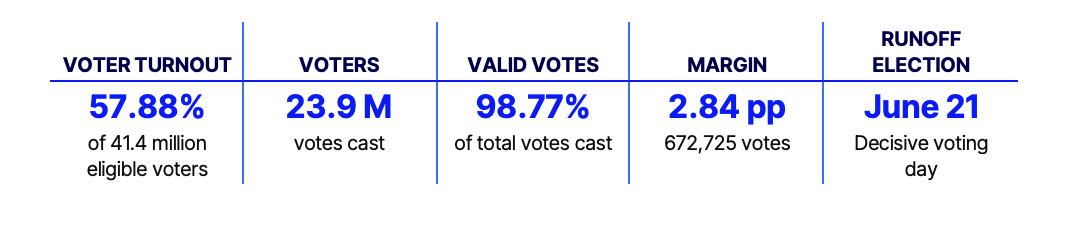
Colombia will head to a runoff election on June 21, 2026. Abelardo De La Espriella (43.74%) and Iván Cepeda Castro (40.90%) will compete for the Presidency of the Republic in a race decided by a margin of 2.84 percentage points. Election day, the most closely monitored in the country's recent history, proceeded without major incidents and was described by international observers as transparent and orderly.
Electoral Integrity
The first round of voting on May 31 was conducted under normal conditions, with an unprecedented institutional deployment in the country’s electoral history.
More than 1,300 international observers from 22 countries and 26 organizations were present throughout the national territory, nearly three times the number that participated in the 2022 runoff election. The European Union Election Observation Mission (EU EOM), led by Esteban González Pons, Vice President of the European Parliament, stated that the election day was conducted in an “orderly, transparent, and incident free” manner at the polling stations observed across the country.
US Republican Senator Bernie Moreno, who attended as an international observer, was unequivocal in his assessment: “Democracy won today.” National Registrar Hernán Penagos thanked poll workers and oversight bodies for their efforts and affirmed that the vote consolidation process continued normally.
Less than two hours after polls closed, the National Registry’s preliminary count showed a clear and irreversible trend. This level of speed in reporting results reaffirmed the technical and institutional strength of Colombia’s electoral system and significantly reduced the scope for questioning the legitimacy of the process.
Today, Colombia demonstrated that its democracy is resilient. The institutional capacity to conduct an election of this scale with transparency, efficiency, and under extensive international scrutiny is a reputational asset that the country should proactively leverage with investors, trading partners, and global audiences.
Vote Distribution
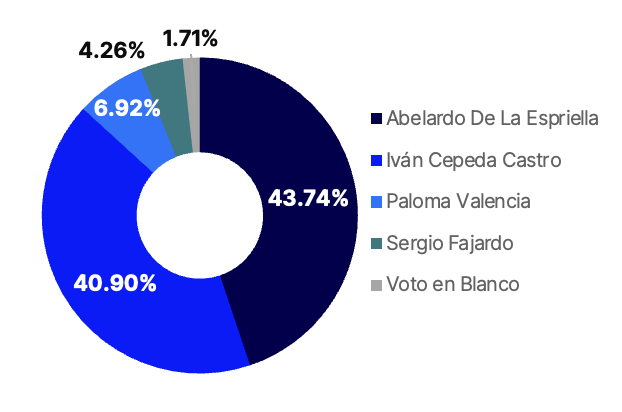
Together, the two runoff candidates captured 84.64% of all valid votes, marking the highest level of two candidate vote concentration recorded in a Colombian first round election in decades. A total of 23,978,053 voters participated out of an eligible electorate of 41,421,973 citizens (57.88%), the highest turnout in the history of the country’s presidential elections. Valid votes accounted for 98.77% of all ballots cast, including 406,968 blank votes, representing 1.71% of the total.
Who’s Who? Profiles of the Runoff Candidates
Abelardo De La Espriella
Defensores de la Patria | Right Wing | Vice President: José Manuel Restrepo
Her position could be more pragmatic than Fajardo’s. If she sees room to influence the next government’s agenda, particularly on anti-corruption measures, public security, and social protection, she could be open to negotiation. Her urban, centrist voter base is likely to become one of the main constituencies contested by the two finalists.
Iván Cepeda Castro
Pacto Histórico | Left Wing | Vice President: Aida Quilcué
Senator, 63 years old. A philosopher and human rights activist, he is the son of Manuel Cepeda Vargas, a Patriotic Union senator who was assassinated in 1994. He has spent more than three decades working in Congress and participating in peacebuilding efforts. He won the Pacto Histórico primary with 65% of the vote and is widely seen as representing the ideological continuity of the Petro administration. His running mate is Aída Quilcué, an Indigenous leader and prominent advocate for ethnic and Indigenous rights.
Political Context and Analysis
Colombia moved toward the extremes: “plebiscite” on Gustavo Petro’s administration than a traditional presidential contest.
The most revealing fact of this first round is not who won, but how Colombians voted: 84.64% of valid votes were concentrated in the two candidates representing opposite ends of the political spectrum. The independent center (Fajardo) and the center right (Valencia) together captured only 11.18% of the electorate, with Fajardo accounting for just 4.26% on his own. This level of concentration has a name: structural polarization. The result confirms a trend increasingly visible across Latin America, where voters are moving away from moderate alternatives and gravitating toward candidates who promise political rupture, whether from the left or the right.
More than a traditional presidential election, this first round functioned as a plebiscite on the government of Gustavo Petro. Support for De La Espriella was, to a large extent, a vote against the administration’s reforms, governing style, economic management, and ideological agenda. Support for Cepeda, by contrast, largely reflected a desire for continuity and the defense of the progressive project launched in 2022. The candidates’ individual platforms mattered less than the position each occupied in relation to the outgoing government. This pattern is not unusual in the region. Over the past year, several left-leaning governments in Latin America have faced a pendulum effect as voters reassess unmet expectations for change.
De La Espriella consolidated a right-wing candidacy with a style, rhetoric, and profile distinct from Colombia’s traditional political establishment. A legal outsider with no prior elected office, he built his public profile through high profile litigation and media exposure. His rise is consistent with the fragmentation of right-wing leadership in the post Uribe era. Following the first-round results, former President Álvaro Uribe openly endorsed his candidacy, while Cambio Radical formally joined his coalition, suggesting a pragmatic consolidation of the right around his campaign ahead of the June 21 runoff.
Cepeda, meanwhile, enters the second round without the momentum that once made him the frontrunner in opinion polls. His principal challenge will be to expand his support among moderate voters who, in the first round, either backed centrist alternatives or chose not to participate.
Looking Ahead to the Runoff Election
The Battleground Vote: 11.18% Could Decide the Presidency.
The behavior of voters whose preferred candidates did not advance to the runoff will be decisive. Paloma Valencia (1,639,668 votes, 6.92%) and Sergio Fajardo (1,009,045 votes, 4.26%) together represent 11.18% of valid votes, a potentially pivotal bloc given the current margin of just 2.84 percentage points between the two finalists.
Valencia has already announced her personal endorsement of De La Espriella. However, none of the prominent figures who appeared alongside her on stage, including Aníbal Gaviria, Enrique Peñalosa, and Mauricio Cárdenas, have publicly announced whom they will support in the runoff. Fajardo, meanwhile, stated that his political sector will play an important role in the coming weeks but stopped short of endorsing either candidate. The transfer of support from these constituencies will not be automatic and will depend on ideological affinities, political negotiations, and voter perceptions of the risks associated with each option.
Abstention will also be a key variable. With turnout reaching 57.88%, a significant share of eligible voters did not participate in the first round. If mobilized ahead of June 21, this segment could materially alter the electoral balance and prove decisive in determining Colombia’s next president.
Statements from the Presidential Candidates
Abelardo De La Espriella
Presidential Candidate | Defensores de la patria
The candidate responded to statements made by Gustavo Petro and Iván Cepeda questioning the legitimacy of the election, asserting that he would not allow “the will of the people to be stolen.” In his remarks, he argued that Colombia is facing a humanitarian and security crisis, criticized the outcomes of the “Total Peace” policy in light of rising attacks and killings, and claimed that the governing coalition may seek constitutional changes to remain in power. He also called on the international community, particularly the United States, to monitor and accompany the runoff election process. De La Espriella thanked the more than 10 million voters who supported his candidacy and said he is prepared for the decisive contest on June 21. He also recognized the contributions of his running mate, José Manuel Restrepo, and his campaign team, highlighting that his movement was able to consolidate without the backing of traditional political structures. The candidate expressed gratitude for Paloma Valencia’s endorsement and called on Colombians to remain united and prayerful ahead of the runoff, reiterating his commitment to advancing the country’s development.
Iván Cepeda Castro
Presidential Candidate | Pacto Histórico
He stopped short of fully recognizing the preliminary results and called for verification of what he described as a “discrepancy,” referring to 886,000 individuals or voter identification records, as well as an unspecified number of polling stations with “atypical voting patterns” allegedly detected by his campaign’s electoral monitoring software. He cited the President of the Republic in support of the need for such a review and stated that he would refrain from making a definitive assessment until the official vote counting commissions advance their work. He also claimed that his campaign had received “10 million miscounted votes” and declared himself the leader of the country’s largest political force. During his remarks, he criticized his opponent, Abelardo de la Espriella, describing him as a lawyer for drug traffickers and fraudsters, and argued that a De la Espriella presidency would dismantle the progressive achievements of recent years. He also questioned the financing of the first-round frontrunner’s campaign and called for a detailed audit of its funding sources and expenditures.
Paloma Valencia
Candidate | Centro Democrático
She stated that she remains committed to serving Colombia and congratulated Abelardo De La Espriella on what she described as an “extraordinary victory.” Valencia argued that the election result reflects the rejection by a significant portion of Colombians of the Petro administration and announced her personal endorsement of De La Espriella for the runoff election. She was joined on stage by Aníbal Gaviria, Enrique Peñalosa, Juan Daniel Oviedo, and Mauricio Cárdenas, none of whom publicly announced their support for either candidate following the first round.
Sergio Fajardo
Candidate | Centro Independiente
He thanked his campaign team and the more than one million voters who supported his candidacy. Fajardo stated that those votes will play an important role in shaping Colombia’s future and emphasized that the voice of his movement will be heard during the next stage of the electoral process. However, he did not announce support for either of the two runoff candidates.
Juan Daniel Oviedo
Vice Presidential Candidate of Paloma Valencia
He distanced himself from Paloma Valencia’s decision to endorse De La Espriella, positioning himself within the more moderate wing of the political center. He stated that he would take several days to evaluate the outcome and would announce his position by June 3. His eventual decision is expected to be one of the key indicators of how centrist voters may align ahead of the runoff election.
What's Next
Runoff Election, June 21: A Highly Competitive Race in a Divided Country
The runoff election is shaping up to be one of the closest contests in Colombia’s recent history. The 2.84 percentage point margin separating the two finalists leaves little room for assumptions and virtually guarantees a competitive race through election day.
The first indication of what lies ahead came from the candidates’ own election night speeches. Neither candidate made an effort to move toward the political center. De La Espriella called on voters to “defeat tyranny and absolutism,” while Cepeda challenged the preliminary results, referred to “10 million miscounted votes,” and described his opponent as a lawyer for drug traffickers. Rather than signaling national reconciliation, both speeches suggested a further escalation of political polarization. The runoff is therefore likely to intensify, rather than moderate, the political debate.
The 11.18% of votes represented by Paloma Valencia and Sergio Fajardo remains mathematically decisive, but the redistribution of those votes is far from guaranteed. Valencia announced her personal endorsement of De La Espriella, while Juan Daniel Oviedo publicly distanced himself from that decision and said he would wait until June 3 before announcing his position. Fajardo also declined to endorse either finalist. Meanwhile, Aníbal Gaviria, Enrique Peñalosa, and Mauricio Cárdenas have remained silent. As a result, the moderate center and center right electorate remains fragmented between ideological preferences and concerns about political polarization, making voter behavior difficult to predict.
Governability Risk: The Real Challenge Begins on July 20
Whoever wins on June 21 will face a structural challenge that extends well beyond the campaign: governing a deeply divided country with a fragmented Congress and no preexisting majority coalition.
If De La Espriella wins, he will need to build legislative support largely from scratch. His movement lacks a consolidated congressional bloc, and its path to power depends heavily on endorsements from parties and political actors that supported other candidates during the first round. The result could be a government with a strong electoral mandate but limited legislative capacity during its opening months.
If Cepeda prevails, he will inherit the political wear and tear of the Petro administration, confront the reality that a majority of voters supported alternatives to the Pacto Histórico in the first round, and face heightened scrutiny from business and institutional stakeholders regarding economic and security policy. His immediate challenge would be to build confidence among sectors that did not support his candidacy.
In either scenario, the first 100 days of the next administration will provide the clearest measure of governability. A country in which 84.64% of voters rallied behind candidates at opposite ends of the political spectrum leaves little room for gradual transitions. Regardless of who wins, the next government will take office with strong electoral legitimacy but also with significant political friction from day one.
Materials presented by Edelman’s Public & Government Affairs experts. For additional information, reach out to Valentina.Dangond@Edelman.com